The Marketing Metrics That Matter in 2026
- January 29, 2026
- 5 minutes read
How your brand gets searched isn’t the only thing that has changed since AI. As it takes over digital behaviour and content across touch points, it is impacting how we measure marketing efficacy at the campaign and program levels.
It is no longer enough to rely on good old performance or brand equity-related metrics. If you are a native marketer, you have already seen this coming. The magic bullet era is past us. Instead, you must work to create relevance across channels and touch points to build a funnel that thrives. This demands aligning your budgets, strategy, and programs to AI-aligned metrics.
Here are top 5 marketing metrics that we cannot recommend enough!
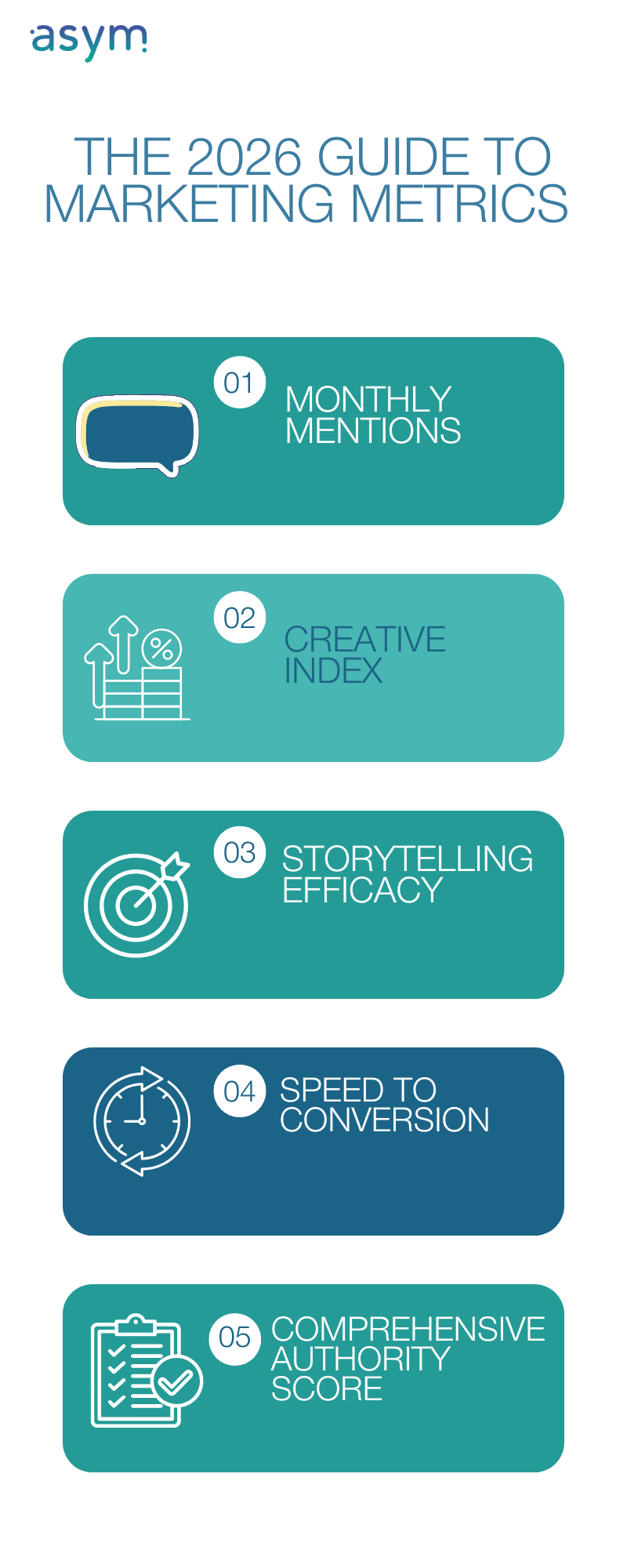
Monthly Mentions
This is the single most important metric that you must measure consistently. Even if you are clear that your revenue growth is tied to performance marketing all the way, getting mentioned by LLMs, creators, and communities is critical to your brand’s revenue. This is because even your most high-performing campaign won’t continue to drive conversions purely on its own weight. As user and consumer behaviour evolves, they are increasingly making their decisions based on recommendations from credible and relevant sources.
This makes it critical that your brand (ecommerce or otherwise) and offerings get cited by relevant sources, consistently.
P.S.: Scoring high on this metric demands investing in an end-to-end integrated marketing and brand ecosystem solution.
Creative Index
This isn’t about how much you rely on AI as your creative co-pilot. You must ensure you hit the nail on the head when it comes to intuitive intelligence. Because when you compromise creativity in the pursuit of targeting tech, you lose out on brand resonance + revenue.
You might be surprised to know what obvious as it may sound, globally marketers are compromising on their campaign creatives and risking as much as 50% dip in sales, as per a Nielsen IQ report (more on that in our newsletter).
This demands you borrow or build your own Creative Index model to measure and align:
- Hook efficacy
- Message resonance
- Sensory experience
- Emotional impact
- Native compatibility
P.S.: Unlike traditional marketing, which involved sentiment analysis and score around big creative campaigns, the new AI environment demands consistent Creative Index scoring across touch points and assets.
Storytelling Efficacy
As a people, we are now drawn into the worlds of storytellers more than ever. As we look for genuine connections, striking narratives are key to a strong stakeholder ecosystem. Yes, as a marketer, you are not just selling to customers but also shareholders, vendors, and the community at large.
Yes, you got that right – this doubles up as a compelling argument with others or your inner demons about marketing budgets for storytelling.
But how do you measure storytelling with a metric? Well, recall is by far the biggest measure, and increasingly, consistency comes a close second.
PS: DM to learn how we leveraged the micro-drama format to drive Storytelling Efficacy for one of India’s largest personal finance brand.
Speed to Conversion (Conversion Rate)
A lot of service-focused businesses track a metric called First Time Resolution. It lets service leaders gauge the seamless of the customers’ experience. In a way, Speed to Conversion is its equivalent. Unlike RoAS or CLV which focus on optimization wins, such a metric lets you understand your wins in terms of the customer journey and experience. When you measure Speed to Conversion, don’t stop at just your website or app’s UX technicalities. Instead, choose to discover and address:
- Multi-touch point journey gaps/wins
- Brand narrative affinity
- Campaign/content persuasiveness
- The relationship between genuine storytelling and sales
Measuring Speed to Conversion for non-linear customer journeys isn’t simple. It demands setting up ecosystems that merge automation and AI with nuanced human observations.
PS: Draw from your full-funnel marketing partner’s expertise in tracking, measuring, and managing non-linear customer journeys.
Comprehensive Authority Score
Now authority score has existed as a metric for websites and domains since a while. But as customer behaviour evolves, we need to extend authority score to cover every touch point in the journey. This calls for a compound approach. Start by measuring your domain’s Authority Score + 360° Sentiment Analysis + Organic PR and Collabs Frequency + Employer Branding Sentiment to begin with. Don’t be overwhelmed. Just start and evolve as you go.
Remember, it’s better than not starting and measuring at all. In a search environment driven by organic, non-formulaic mentions, how and where your brand shows up matters infinitely.
PS: A powerful way to get this metric into your monthly reports is to pre-host a workshop and get your team onboard.
The 1-Minute Roundup
You can’t use old metrics to measure new marketing methods. Sure, those such as Customer Lifecycle Value (CLV) continue to matter. But if you are a marketer who gets how AI is changing the order of things and not just search, you know that it’s time to track and measure metrics in a lot more holistic fashion. Relying on third-party tools and platforms to understand how you score on various parameters is no longer enough. You need to weave in new, nuanced metrics into your marketing ecosystem that align with contemporary marketing goals. A key differentiator is metrics that acknowledge the multi-touch point, non-linear nature of customer journeys instead of limiting efforts to campaign/platform-specific metrics.
DM us to learn more about how at Asymmetrique, we arrive at new age marketing metrics for full-funnel marketing programs!

About Asym
We are on a mission to be the leading solutions partner to growth-focused marketers such as yourself.
We accomplish our mission by crafting unique, high-value solutions that leverage good tech, great talent, and timeless marketing fundamentals.
Are you ready to relicalibrate in an industry that’s lost to chasing trends?